Adapt and Adopt
 James MacLeod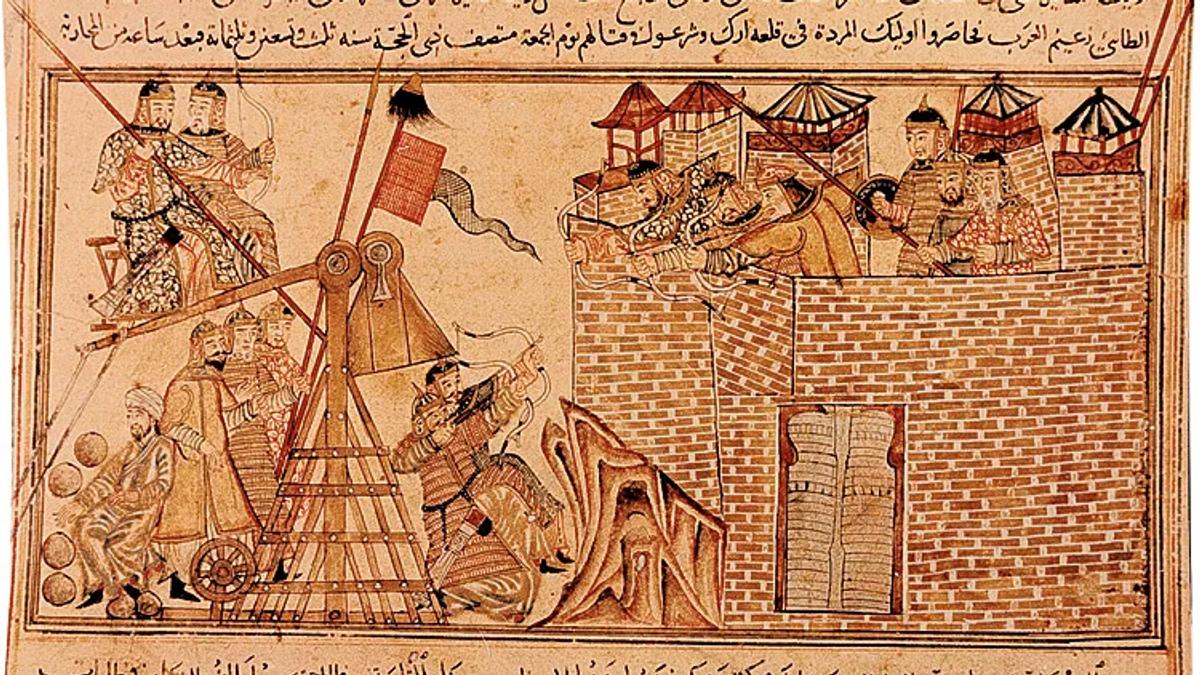
Adaptability is a skill a lot of us have had to learn. I’ve had to (and more importantly continue to) do this throughout a pretty varied career.
Another thing I have never been afraid to do is adopt new ways of doing things, be they in the work place, or new opinions based on my adapting perspective as my viewpoint broadens with experience.
Adapt and adopt. From my perspective, one of the key strengths of Mongol doctrine under Genghis Khan.
How so, you ask? Well, he drew together the warring tribes of the Mongolian steppe under one banner and created the largest contiguous land empire the world had ever seen. And he did it by cunning use of horse warfare and deception.
But horses ain't great against a city wall, and deception isn't always successful. What is always successful is a big freaking rock thrown through the air by a lever powered by the sudden conversion of potential energy to kinetic energy. But the Mongols didn't have siege weapons. They were Steppe warriors; excellent with bow, spear, and sword, right?
So, how do a roving nation of horse warriors develop complex siege engineering within the space of a decade or so? They don't. They adopt the technology and even the experts in that technology into their nation and armies.
One example is during the Mongol conquest of the Song Dynasty in Southern China. The Mongols under Kublai had hit a roadblock with two fortress cities on their path into the south. These fortresses were impregnable to the means the Mongols had at this point (namely previously adopted Chinese torsion catapults). Kublai sent to Persia and obtained engineers who built him trebuchets. These machines utilised massive counterweights to lob heavy stuff really far. And these machines made short work of the first fortress. The second surrendered shortly afterwards.
Genghis and his descendent khans were expert in adopting and accepting various cultures and practices into their empire. There was a tolerance of religion and race that many nations today could learn well from.
So there is adoption. Simple. Adaptation though? Harder to define, but here again the Mongols can help us.
The world Genghis' empire was born into adapted slowly to the Mongol threat, which meant the Mongols were able to conquer vast tracts of Asia and even parts of Eastern Europe. And to do this, facing a variety of enemies, peoples, doctrines, and the rest, the Mongols had to be adaptable. They prized initiative in their commanders, which ties in nicely with another blog post I have done on the importance of empowerment.
This initiative ensured commanders all the way down could make quick decisions that suited what they were facing.
And those quick decisions? The modular hierarchy, from the arban of ten all the way up to the tumen of ten thousand, of the Mongol armies meant lessons were shared and fed back up, being adopted by the whole when successful, meaning the next time the slow to adapt enemy was on the other side of the battlefield, the Mongols facing them knew exactly what they needed to do to defeat them. It is worth noting they weren’t invincible, and despite popular opinion, plenty nations and peoples did eventually adapt enough to turn back the tide.
And there we are. Adaptation.
Both of these, adoption and adaptation, are why the agile and growth mindsets are so prized in the fast paced world so many of us find ourselves working in.
The lessons we can learn from history, particularly in the early years of the Mongol empire and their conflicts with sluggish enemies, highlight the pitfalls of dogma and narrow minded approaches.
All too often I have seen someone learn a new system to manage a project or task and apply it at the expense of reason (we’ve all met maniacs who throw up a Kanban to make a cup of coffee). No one system or solution is perfect. There is no panacaea of golden gun, so you must adapt that imperfect system to fit the context you are applying it in. And if it doesn’t fit after a load of effort, drop it and look at another way.
Reflect on what has come before, even looking beyond the team you find yourself in. An adjacent team have probably faced the same issue.
And if they have, adopt their solution. And do it vocally. Credit where credit is due. And as my good friend James often says, recognition is an important part of happiness at work. This transparent adaptation and adoption will make you and your team more effective and robust, whilst encouraging collaboration between those modular entities that make up an organisation, sometimes not too dissimilar to the tumens and arbans or the Mongol army.